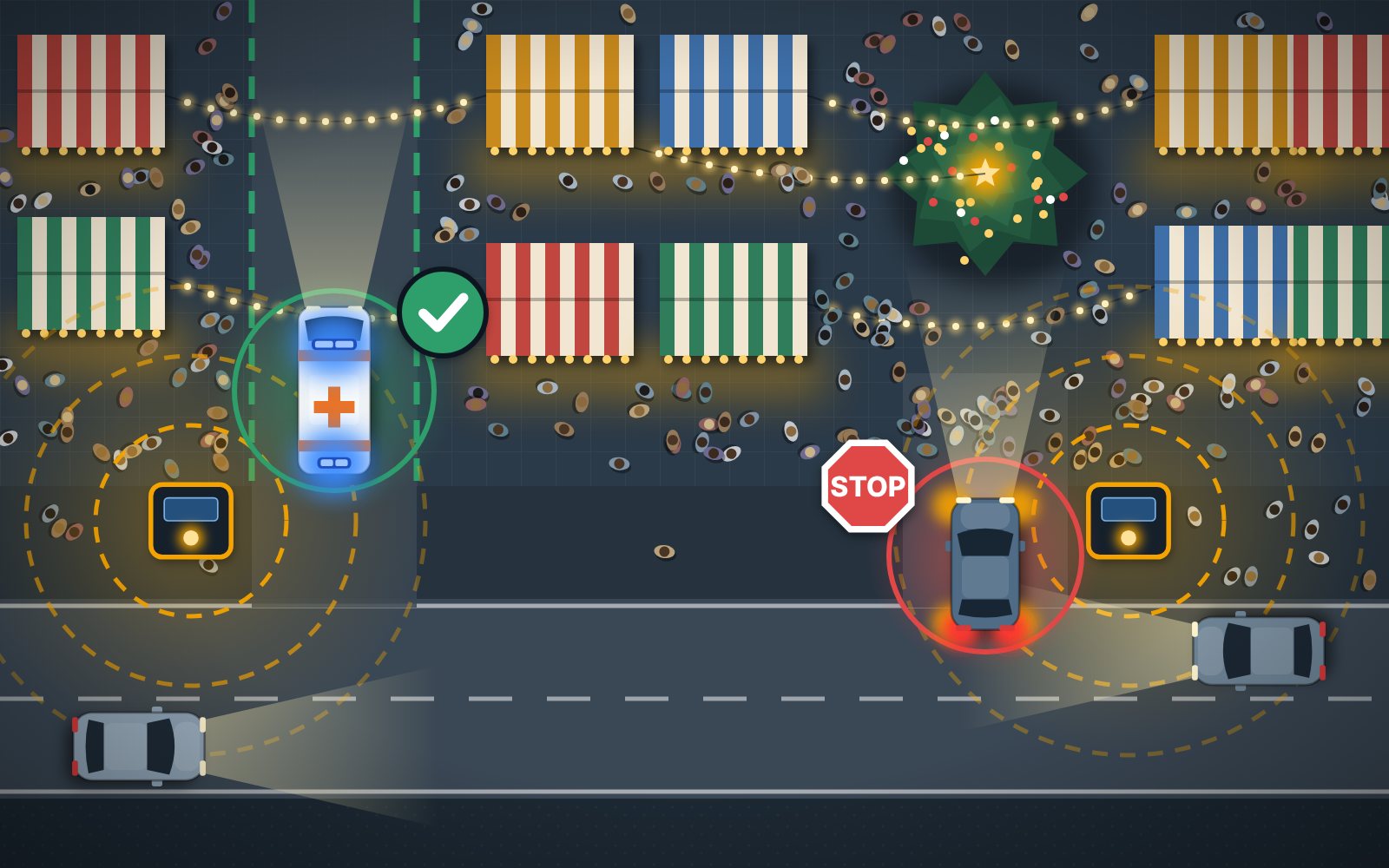
Protect events
Mobile stand-alone units at the entrances instead of concrete barriers. Escape routes stay clear and emergency vehicles pass through unhindered.
Safe-Stop Safety system for motor vehicles
A tamper-proof, digitally signed radio signal stops exactly one vehicle. The vehicle verifies the signal itself, without internet, mobile network or GPS. Steering, brakes and hazard lights remain active.
Vehicles are deliberately used as weapons, for example in ramming attacks on public events. Or they become a danger unintentionally, like wrong-way drivers on the motorway.
High construction effort and inflexible for temporary sites. Emergency vehicles struggle to get through. As a result, many events become expensive or are no longer held at all.
They fail in dead zones or under interference, cause ongoing costs and open up an additional attack surface.
Without secure authentication they could be manipulated. A forged signal must never be able to stop a car.
The goal: stop safely. No bollards, no network.
The transmitter can be a handheld device, a mobile stand-alone unit or a fixed transmitter mast. This lets the system adapt to events, roads or factory gates.
Mobile stand-alone units at the entrances instead of concrete barriers. Escape routes stay clear and emergency vehicles pass through unhindered.
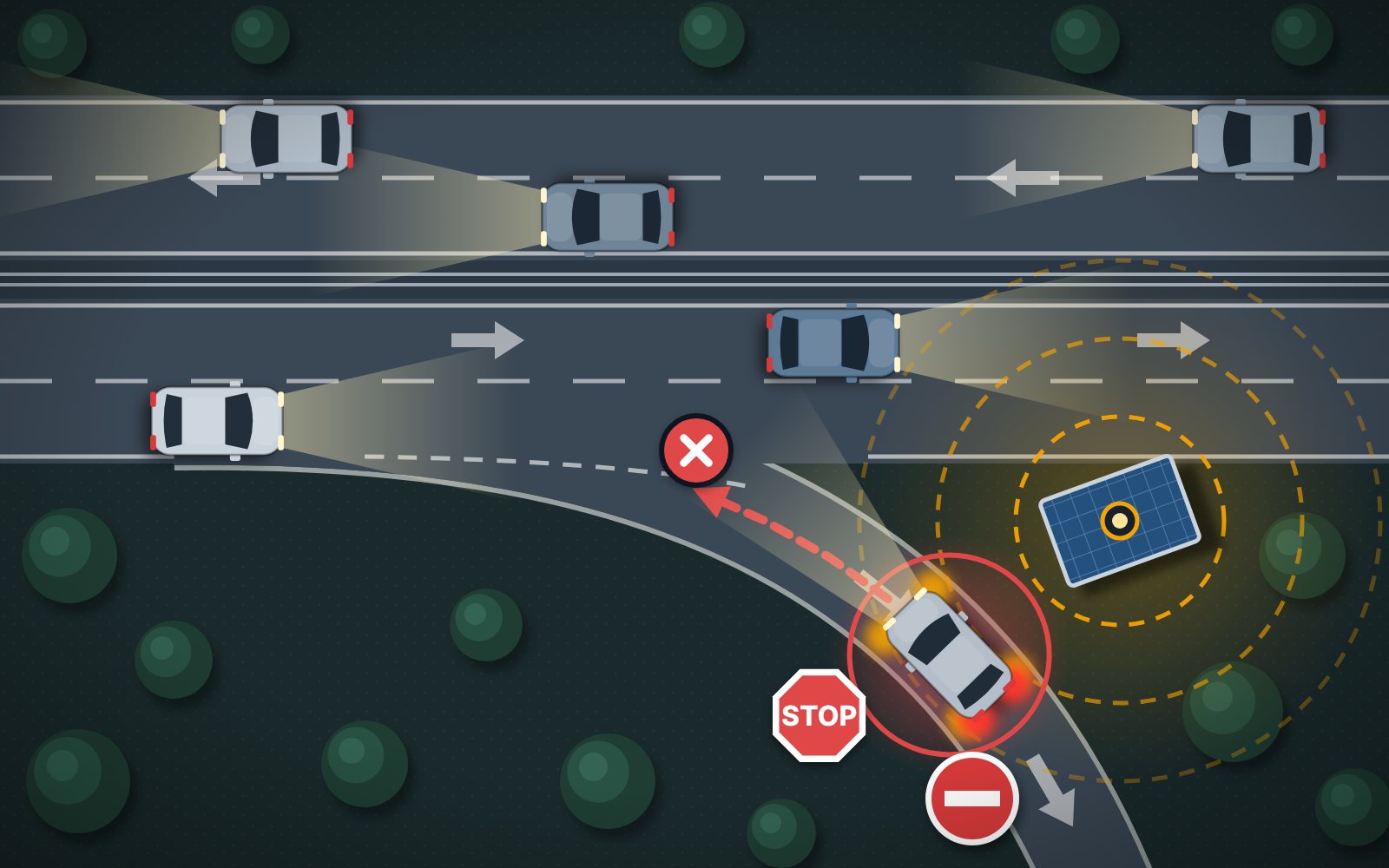
A transmitter mast at the motorway slip road detects the direction of travel and stops the vehicle before it becomes a danger.
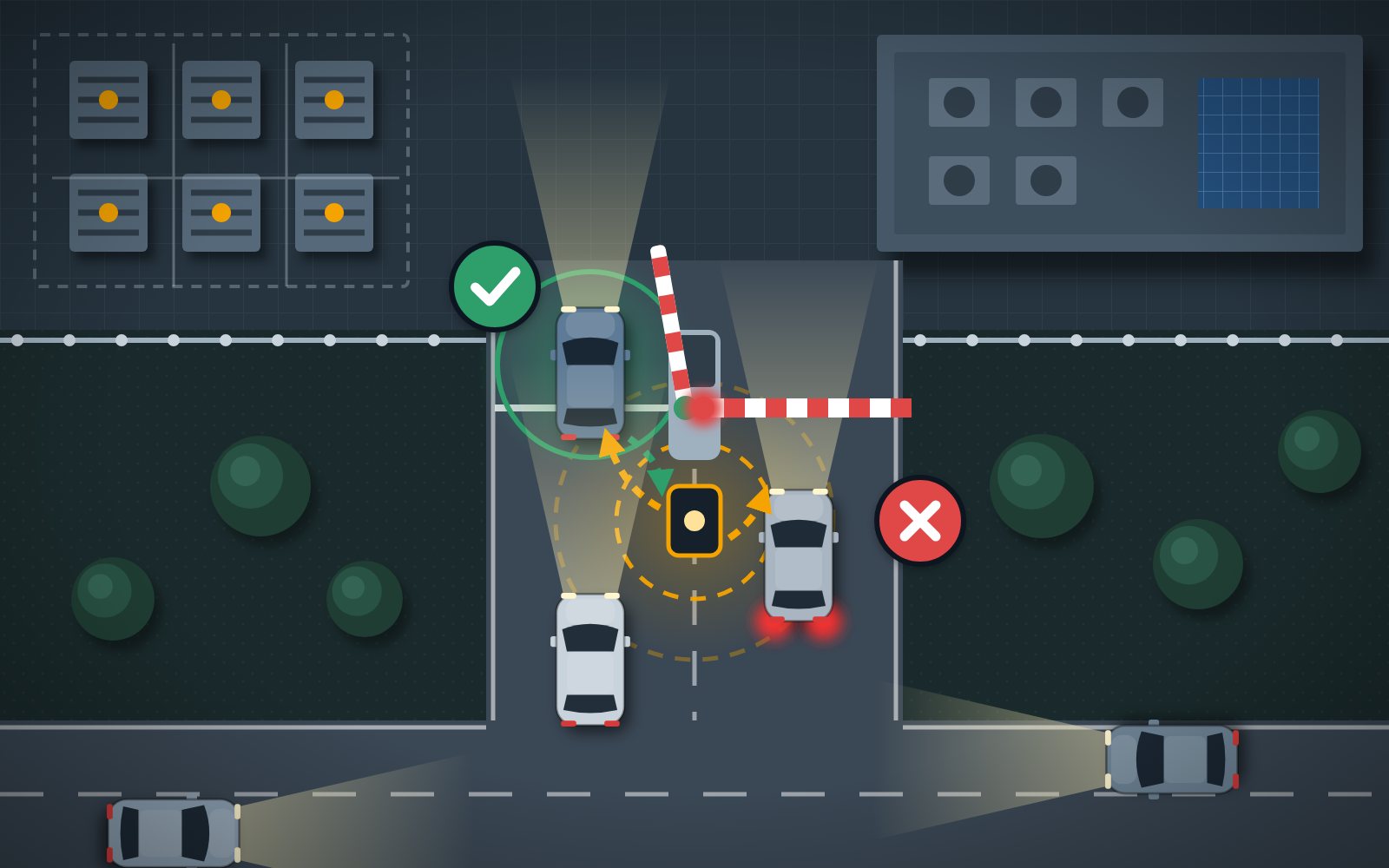
Status check without stopping: the barrier opens only for vehicles with an active receiver. Suitable for industrial sites and critical infrastructure.
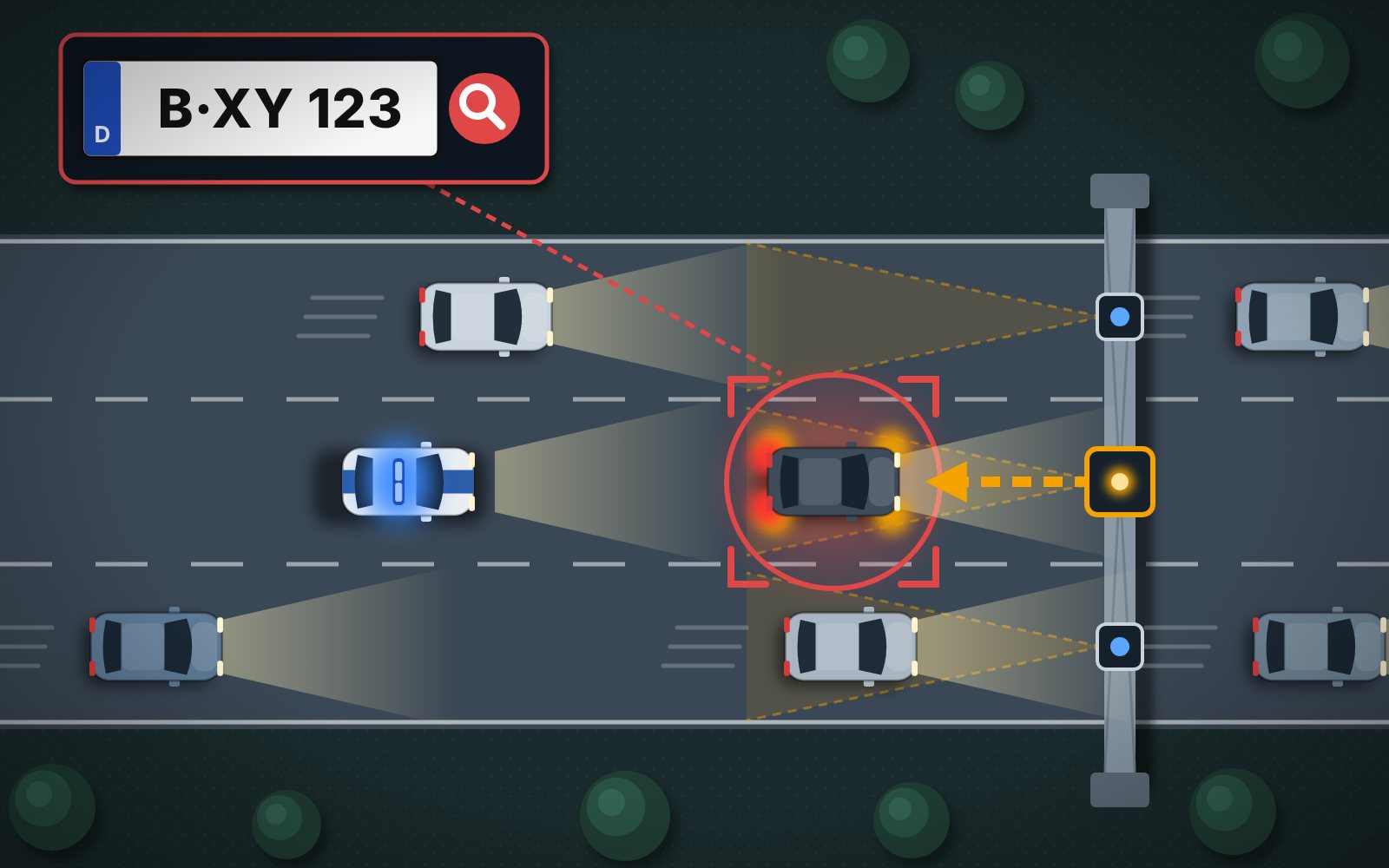
A number plate reader detects a wanted getaway vehicle. Only that vehicle is stopped, making pursuits unnecessary.
Also: ending police pursuits and securing restricted zones and critical infrastructure. All scenarios in detail
Every scenario follows the same sequence: assess the situation, send a signed stop signal, bring the vehicle to a controlled stop.
Protection without concrete barriers. Escape routes stay clear.
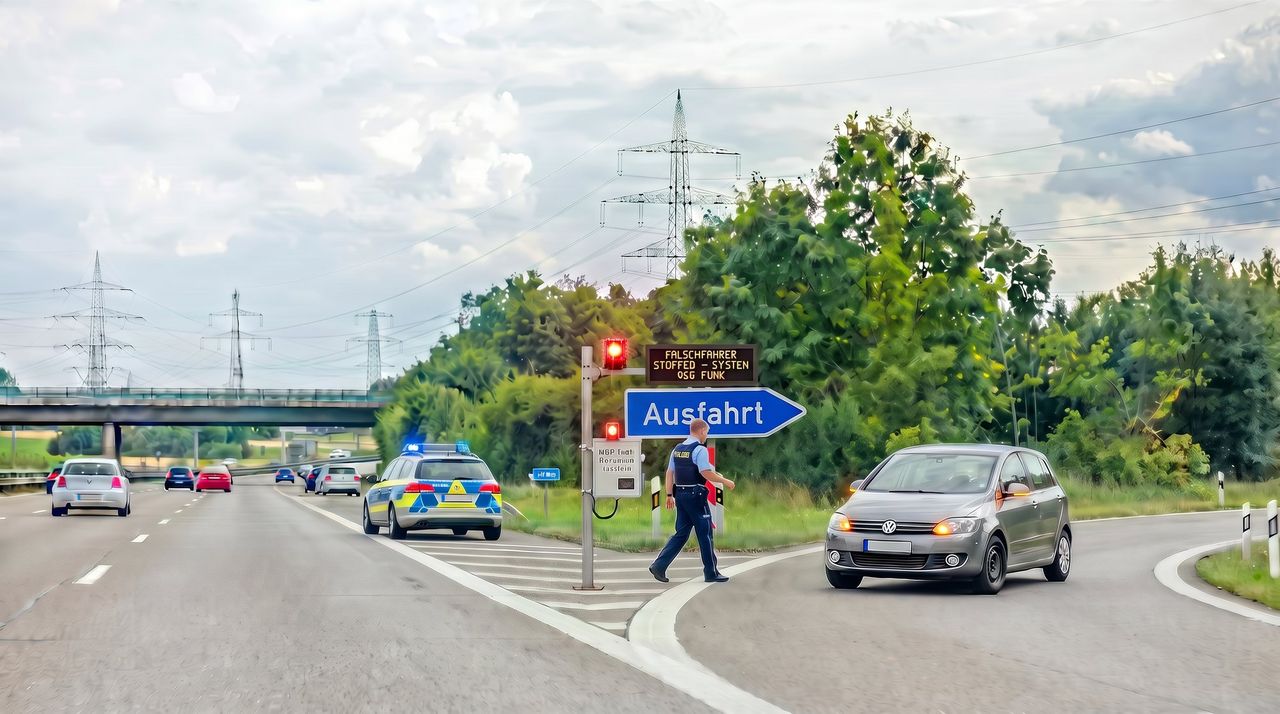
An unintentional danger stopped before a head-on collision occurs.
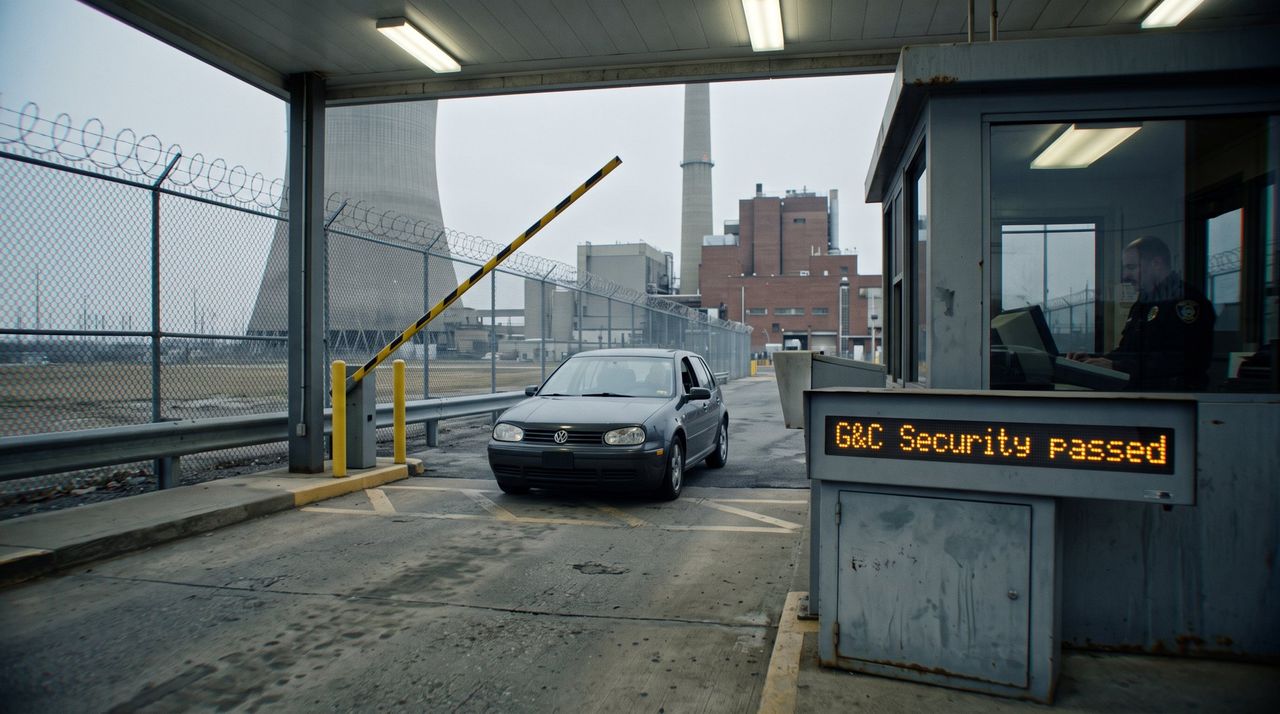
Only vehicles that can be stopped at any time are granted access to sensitive areas.
Targeted, not blanket: each signal applies to exactly one vehicle.
Pursuits end safely, for bystanders and officers alike.
Videos and photos are AI-generated visualisations of the application scenarios.
Only the central authorisation authority can generate a valid stop signal. The vehicle verifies it locally using a public key.
Holds the private key and signs the stop signal for exactly one vehicle. The private key never leaves the authorisation authority.
↓ encrypted internet connectionHandheld device, stand-alone unit or transmitter mast. It does not know the key and only transmits the finished signature.
↓ short-range radioVerifies the signature with the public key, locally and without internet or GPS.
↓ switching output / engine control unitFuel or power supply is cut. Steering, brakes and hazard lights remain active.
Verification runs entirely in the receiver. It needs neither a network nor location data.
Safe-Stop prevents a motor vehicle from being used as a weapon, whether deliberately or unintentionally.
Verification in the vehicle, without internet, mobile network or GPS. Works even in dead zones.
The private key stays at headquarters. Replayed signals are rejected.
Only the addressed vehicle is stopped. Emergency services have a clear way through.
Can be integrated at the factory or installed as a module between battery and on-board power supply. Updates via app.
Christmas markets and festivals can be secured with far less construction effort, instead of being scaled down or cancelled.
Public gatherings can continue to take place safely. A contribution to an open, democratic society.
The invention is patent pending and a working demonstrator is available. The next steps are expert validation, pilot applications and series production.
German patent application with the German Patent and Trade Mark Office (DPMA): “Safety system for motor vehicles and method”.
Microcontroller-based software with Bluetooth Low Energy and Ed25519 signatures. Security logic tested, including attack scenarios.
Expert meetings with live demonstrations, a pilot application with first users, talks on licensing or a development partnership.
Independent assessment of the cryptography and vehicle IT security, joint funded projects.
Requirements from operational practice: tactics, legal basis, protection against misuse.
Pilot application to protect markets, festivals and public gatherings.
Suppliers and manufacturers as licensees for the receiver module, factory-fitted or as a retrofit.
Truck and rental fleets with high damage potential, centrally retrofittable.
Only signals signed by the central authorisation authority with its private key are executed. Transmitters do not know this key and only receive authorisations limited in time and number. Each signal applies to exactly one vehicle, and replayed signals are rejected.
The drive is cut while steering, brakes and hazard lights remain active. Exactly how stopping at high speed works in detail will be defined together with manufacturers and security researchers.
Yes. Verification takes place locally in the vehicle, without internet, mobile network or GPS. Only the transmitter needs a secure connection to the authorisation authority beforehand.
No. The system is designed for stopping, not tracking. It does not require continuous transmission of location data.
Police, fire and ambulance services receive an exemption status. It can be revoked in case of misuse.
Voluntary applications, for example on industrial sites or in fleets, can be governed by contract. Use by public authorities requires a basis in police and road traffic law; mandatory fitting would be possible via EU type approval. We are clarifying these questions together with authorities and partners.
Vehicle manufacturers must comply with UN Regulations R155 (cybersecurity management system) and R156 (software updates). The receiver module will be integrated into these processes.
We would be happy to present the system to you in a meeting of around 30 minutes, either on site with a live demonstration or via video call.
We share technical details once a non-disclosure agreement has been signed.
Inventor · 83361 Kienberg, Germany
caus@safe-stop.de+49 171 4640274Inventor · 83361 Kienberg, Germany
gmeindl@safe-stop.de+49 179 7862519